
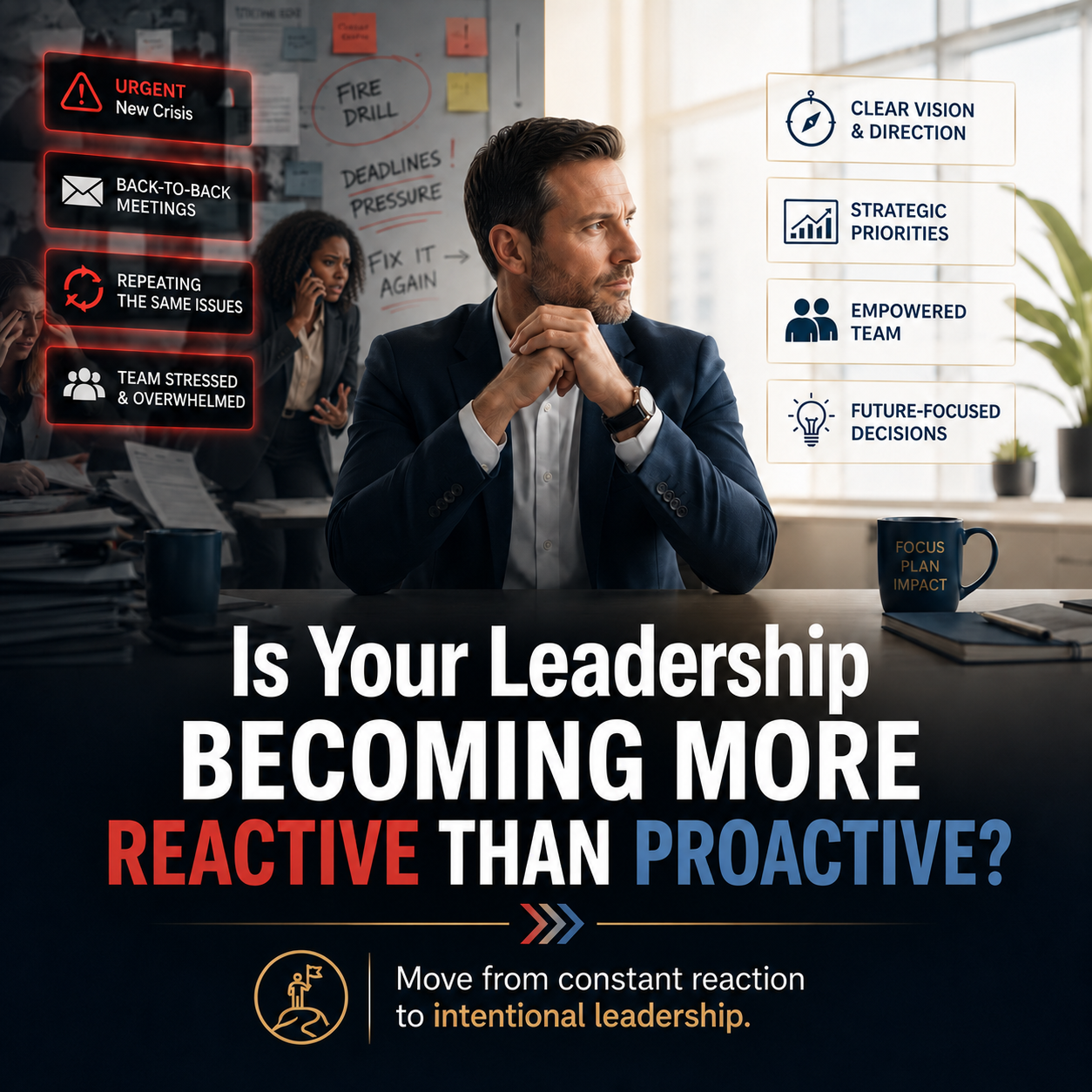
Nobody steps into leadership hoping to spend most of their time managing one crisis after another.
Most leadership roles are described with terms such as visionary, strategic, inspiring, or transformational. The invitation is usually about shaping culture, developing people, improving results, and helping an organization move toward a better future. That is what draws many people into leadership in the first place.
But the daily experience often looks very different. Instead of focusing on strategy and long-term growth, many leaders find themselves pulled into constant decision-making, repeated escalations, avoidable confusion, and problems that keep resurfacing because no one has addressed the underlying causes.
That is the quiet tension many leaders carry. They entered leadership to make an impact, but their days are often shaped by whatever feels most immediate.
Over the past two weeks, I have had the privilege of sitting in four different leadership conversations with four very different clients across different industries. Each organization had its own culture, challenges, and goals. Yet one theme kept showing up in every conversation: many leaders are leading from behind.
These leaders are capable, thoughtful, and deeply committed. They care about their teams and want to lead well. The issue is that the pace and patterns of their organizations have slowly pushed them into response mode. Their time is fragmented, their energy is stretched, and their attention is constantly pulled toward the next issue to be handled.
Somewhere along the way, the work of leadership became the work of reacting.
The Slow Drift into Reactive Leadership
Reactive leadership usually develops gradually. It begins with small patterns that seem manageable in the moment. A decision gets pushed upward that someone else could have made. A recurring issue is handled quickly rather than examined carefully. A difficult conversation gets delayed because there are more pressing matters to manage. A meeting gets added to solve a problem that might have been prevented with clearer expectations.
At first, these patterns may seem like part of the job. Over time, they become the job.
The challenge is that reactive leadership can feel productive. Leaders are busy, responsive, and needed. They answer questions, solve problems, make decisions, and keep things moving. From the outside, it can look like strong leadership is happening.
But movement is different from momentum. Activity is different from alignment. A leader can be constantly in motion and still have very little space to guide the organization forward.
A reactive leader asks, “How do I fix this again?”
A proactive leader asks, “Why does this keep happening in the first place?”
That difference matters. One question keeps the leader at the center of every issue. The other strengthens the people, systems, and culture around them.
When Leaders Lose the Space to Lead
Most people enter leadership because they want to make a meaningful contribution. They want to develop people, build healthy teams, shape culture, make thoughtful decisions, and move the organization forward. That is the real work of leadership.
But meaningful leadership requires space. It requires reflection, intentionality, and the ability to step back long enough to see patterns instead of simply responding to problems.
When leaders spend most of their time reacting, that space disappears. The urgent begins to control the important. Short-term pressure begins to crowd out long-term thinking. Over time, leaders can start measuring their effectiveness by how much they handle rather than how much they prevent.
That kind of leadership creates exhaustion disguised as productivity. Things may still get done, but often at the expense of clarity, strategy, team development, and long-term culture building. The organization keeps moving, but movement alone does not mean it is moving in the right direction.
The Hidden Cost of Being the Go-To Person
One of the greatest risks of reactive leadership is that it teaches the organization to depend too heavily on the leader.
When a leader repeatedly solves problems others should own, the team learns to send more problems upward. When a leader steps in too quickly, someone else misses the opportunity to build judgment and confidence. When a leader postpones a needed conversation, the issue usually becomes more expensive later. When strategic time gets crowded out, the organization loses the benefit of forward-thinking leadership.
Over time, this creates an unhealthy cycle. Teams become less confident, leaders become more exhausted, issues keep returning, and the organization becomes dependent on heroic leadership instead of healthy systems.
That approach may work for a season, especially when a leader is highly capable. But it eventually limits growth. Organizations become stronger when leaders build others' capacity, clarify expectations, strengthen communication, address root causes, and create systems that reduce unnecessary confusion before it becomes a crisis.
Moving from Reaction to Intention
Shifting from reactive to proactive leadership does not mean leaders avoid urgent issues. Problems will still happen. People will still need support. Unexpected situations will always be part of organizational life.
The shift is about refusing to let urgency become the default way of operating.
Proactive leadership begins with better questions:
· What am I repeatedly handling that needs to be addressed at the root?
· What decisions are coming to me that should be owned elsewhere?
· What does my use of time reveal about what I truly value?
· Where am I creating dependency when I should be building capability?
· What conversation could prevent future confusion, frustration, or conflict?
These questions move leaders beyond the immediate issue and help them examine the underlying patterns. They invite leaders to shift from managing symptoms toward building healthier systems, stronger teams, and clearer expectations.
Proactive leadership is about leading differently. It means protecting time for strategy, investing in people before issues escalate, creating rhythms that support better decision-making, and remembering that leadership is more than responding to what is loudest. Leadership is giving attention to what matters most.
Reclaiming the Role of Leader
Your organization needs more than someone who can handle today’s problems. It needs someone who can look ahead, build culture, develop people, and create the conditions for tomorrow’s success.
That kind of leadership requires intention. It requires the courage to address root causes, the discipline to protect strategic time, and the commitment to build capability across the team.
Constant crisis management should never become the measure of leadership commitment. Exhaustion should never be confused with effectiveness. And leaders should never have to carry what the organization itself needs to learn how to solve.
Leadership was meant to be more than a cycle of reaction. So here is the question worth asking:
Is your leadership becoming more reactive than proactive?
And if it is, what is one intentional shift you can make this week to begin reclaiming the role you actually signed up for?