
AI Can Do Your Job. Can It Do Your Leadership?
A few weeks ago, I found myself in a conversation with a group of leaders discussing artificial intelligence.
The conversation started where most AI conversations start these days.
Would it replace jobs?
Would organizations become more efficient?
How quickly should leaders adapt?
Who was already falling behind?
At one point, someone asked a different question.
"Do you think AI could eventually replace managers?"
The room got quiet.
Not because people hadn't considered the possibility.
Because they had.
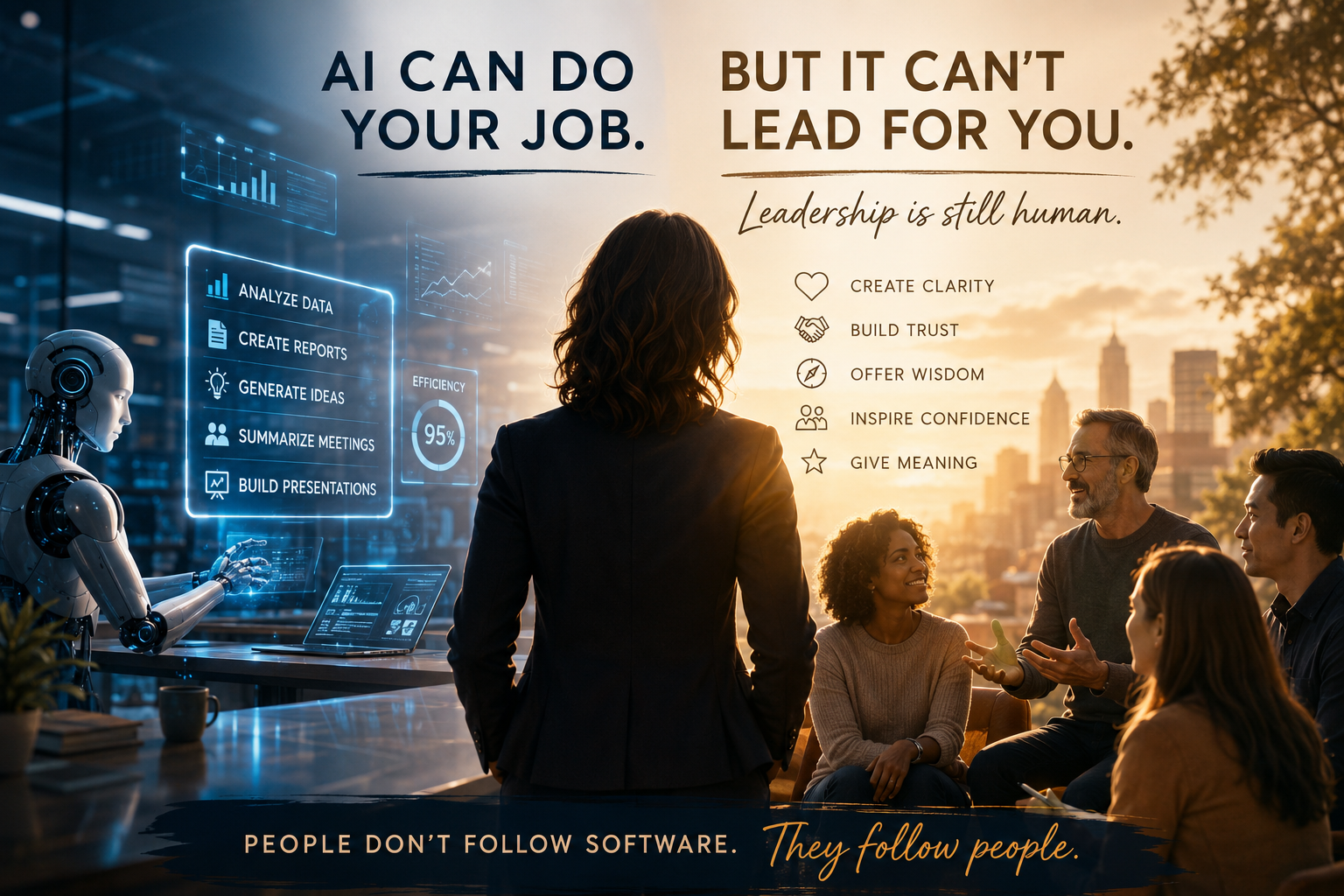
And if we're honest, many leaders are carrying around a low-grade anxiety about that very question. AI seems to be getting better every week. It writes reports, creates presentations, analyzes data, summarizes meetings, and generates ideas that would have taken teams hours, sometimes days, to develop.
It's impressive.
It's exciting.
And depending on the day, it can be a little unsettling.
But the more I've reflected on that conversation, the more convinced I am that we're focused on the wrong issue.
The question isn't whether AI can do our jobs.
The question is whether it can do our leadership.
And those are not the same thing.
For a long time, many of us confused expertise with leadership. We assumed that the person with the most knowledge, the best answers, or the most experience naturally became the leader.
In some organizations, that's still the assumption.
But the world is changing.
Today, information is available almost instantly. An employee can use AI to research a problem in minutes. A board member can generate strategic options before a meeting. A new manager can access insights that once required years of industry experience to uncover.
Information is becoming abundant.
Wisdom is not.
That's why I believe AI is doing something most people haven't noticed yet.
It's exposing the difference between management and leadership.
Management is largely about organizing, coordinating, measuring, and executing. Those activities matter. Every healthy organization depends on them.
But leadership operates in a different space.
Leadership creates clarity when people feel overwhelmed.
Leadership creates confidence when uncertainty is high.
Leadership gives meaning to work that might otherwise feel routine.
Leadership helps people believe tomorrow can be better than today.
The more I think about it, the more I realize that AI may become an extraordinary management tool.
I'm far less convinced it can become a leader.
Think about the best leader you've ever worked for.
Not necessarily the smartest person in the room.
Not the one with the most impressive title.
Not the one with the longest résumé.
The person you'd follow again tomorrow if given the chance.
What made them different?
When I ask leaders that question, they rarely talk about technical expertise.
Instead, they talk about trust.
They talk about character.
They talk about courage.
They talk about the leader who stood by them during a difficult season, challenged them to grow, or helped them navigate a setback they didn't think they could overcome.
Those are the moments that stay with us.
Not the spreadsheets.
Not the dashboards.
Not the reports.
The human moments.
And that's where I believe the future of leadership becomes incredibly interesting.
As technology becomes more capable, the value of deeply human leadership increases.
Trust becomes more important.
Empathy becomes more important.
Discernment becomes more important.
Character becomes more important.
When everyone has access to answers, people start looking for wisdom.
When everything moves faster, people start looking for stability.
When uncertainty increases, people start looking for leaders who know who they are.
Maybe that's why so many respected leadership thinkers keep returning to similar themes. Adam Grant writes about rethinking assumptions. Simon Sinek emphasizes trust and purpose. Brené Brown talks about courage, vulnerability, and human connection.
Different voices.
Different audiences.
Yet they all seem to arrive at a similar conclusion.
Leadership is fundamentally about people.
Technology may change how we work.
It doesn't change what people need from their leaders.
In fact, it may amplify those needs.
That's where I think many organizations are missing an important opportunity.
They're asking, "How can AI make us more productive?"
That's a good question.
But there's a deeper one.
"Who are we becoming while we use it?"
That's a leadership question.
More specifically, it's a Triple Loop Leadership question.
It's easy to focus on what AI can do for us. The harder challenge is examining what it might be doing to us.
How is it changing the way we communicate?
How is it influencing the way we think?
How is it shaping our relationships?
How is it impacting our ability to be fully present with the people around us?
Technology always changes behavior.
The challenge is making sure it doesn't change our values.
Because at the end of the day, nobody commits to a mission because an algorithm told them to.
Nobody perseveres through adversity because a chatbot inspired them.
Nobody follows software.
People follow people.
They trust people.
They believe in people.
And despite all the headlines about artificial intelligence, I don't think that's changing anytime soon.
If anything, AI is reminding us what leadership has always been about.
So yes, AI may be able to do parts of your job.
It may write faster than you.
It may analyze more data than you.
It may process more information than you could absorb in a lifetime.
But it cannot replace your character.
It cannot exercise wisdom on your behalf.
It cannot earn trust for you.
It cannot live your values.
And it cannot lead.
The leaders who thrive in the years ahead won't be the ones competing with AI.
They'll be the ones becoming more human because of it.